
Gold set a record, surpassing $5,400 per ounce in early 2026, then dropped more than $1,400 by early October. Swings that large can leave many jewelry owners and buyers wondering what influences the price of gold in the first place.
The main factors affecting the price of gold range from the strength of the US dollar to how much new gold is mined each year. Those same factors shape what gold jewelry costs to buy and what it’s worth when sold.
Key Takeaways: Factors Affecting The Price Of Gold
- Gold prices rise when demand outpaces supply, and mining adds only a limited amount of new gold each year.
- A weaker US dollar usually pushes gold prices up, and a stronger dollar usually pulls them down.
- When inflation rises or the economy feels uncertain, more people buy gold to protect the value of their savings, which pushes prices up.
- Central banks in countries like China, India, and Russia have been adding gold to their reserves.
- Jewelry sells for more than the value of its gold because of karat purity, craftsmanship, and brand names.
What Are The Main Factors Affecting The Price Of Gold?
No single factor sets the price of gold. Its price moves with a combination of many market forces, and those forces sometimes pull in opposite directions. Following gold market trends starts with knowing the biggest gold price drivers, which also explains why gold prices change so often.
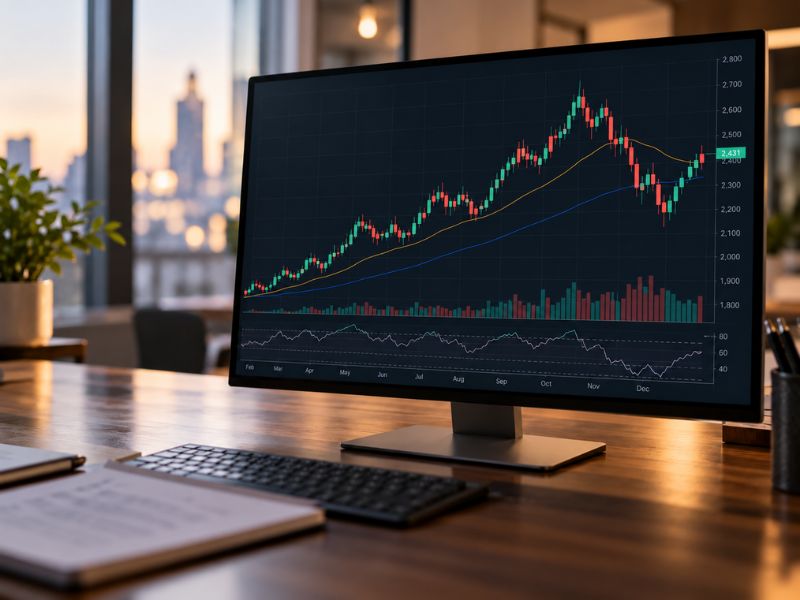
Supply And Demand For Gold
Like any limited resource, gold gets more expensive when buyers want more of it than is available. An increase in gold demand typically leads to higher prices.
Gold supply and demand typically involves three main groups of buyers.
The jewelry industry is the largest group of buyers, accounting for about half of all gold demand. Jewelers buy more gold when the economy grows and people spend more. However, jewelry buying is one of the weaker drivers of gold prices because most people keep their jewelry pieces for years. Someone buys a necklace for a birthday or a ring for an engagement and keeps it for decades. They aren’t reacting to the dollar or the news, and they aren’t selling the piece back when prices jump. That makes jewelry demand slow and steady, so it rarely causes sudden spikes or drops in gold prices.
Manufacturers account for another 10% to 15% of demand, using gold in electronics, healthcare, and space exploration. Investors make up the third buying group. They buy gold as bars, coins, and exchange-traded funds (ETFs), which are investment funds that hold gold and trade like stocks. More money flowing into these investments can push prices higher.
Strength Of The US Dollar
Gold is priced in US dollars around the world, so the dollar’s strength directly affects what gold costs. When the dollar weakens, it takes more dollars to buy the same ounce of gold, which pushes the price of gold up. When the dollar strengthens, gold becomes more expensive for buyers paying in other currencies, so demand often drops and prices tend to fall.
Interest rates can add another layer to the price of gold. Gold pays no interest, so when rates rise, savings accounts and bonds become more attractive investment options by comparison. Because of this, higher interest rates have traditionally pulled gold prices down, but the pattern isn’t consistent. In December 2023, gold prices hit a record high (for the time), while US interest rates were at their highest level since 2007.
Inflation And The Rising Cost Of Living
When the cost of groceries, gas, and rent keeps climbing, each dollar buys less. Many people turn to gold during these stretches because it has historically held its value when cash loses purchasing power, causing demand for gold to climb when the cost of living does.
Economic uncertainty and global conflict have a similar effect. When the economy looks shaky or war breaks out, more people buy gold to protect their money, and that rush of buying pushes prices up. For example, concerns about the COVID-19 pandemic helped push gold past $2,000 per ounce for the first time in August of 2020, and gold prices rose 6% in the first quarter of 2022 as the Russia-Ukraine conflict unfolded. Price jumps tied to world events often fade once tensions ease.
Central Banks Stocking Up
A central bank is the government institution that manages a country’s money, such as the Federal Reserve in the United States. Central banks keep gold as part of their national savings, known as reserves, as a safeguard against financial turmoil. A World Gold Council survey found they value gold for how it performs during a crisis and its ability to hold value over time. In recent years, central bank gold buying has picked up, with China, Russia, and India buying gold at a faster pace.
Much of this buying followed the freezing of Russian assets after its invasion of Ukraine, which showed other countries the importance of keeping control of their own reserves. When large central banks buy, the added demand for gold pushes the price of gold higher.
Limited Mining Supply
Gold is a finite resource, and finding and mining it continually gets harder and more expensive. Mining adds roughly 2,500 to 3,000 metric tons of gold each year, which usually isn’t enough to meet global demand. Global production has also plateaued over the past decade.
Gold supply can’t catch up quickly when demand jumps. Opening a new mine takes years, and labor strikes, environmental rules, and political problems in mining regions can slow production further. When demand outpaces what mines can supply, gold prices rise.
Why Does Jewelry Cost More Than The Price Of Gold?
The factors affecting the price of gold set what raw gold is worth, but a finished piece of jewelry often cost more than just the price of gold. Gold’s spot price is the market price of pure gold at any given moment, and it can change by the second. Whereas, a piece of jewelry’s price depends on a combination of things, including how much gold it actually contains, the work that went into making it, and the name or jeweler behind it.
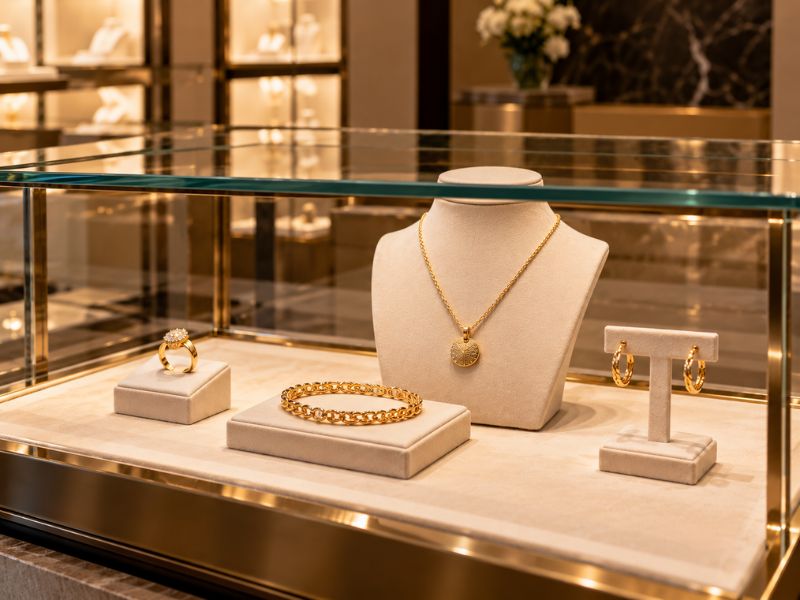
Karats measure how much of a piece is pure gold, counted in parts out of 24. Pure gold is soft, so most jewelry mixes it with other metals for strength.
- 24K is 99.9% gold and is used mostly for bullion.
- 18K is 75% gold.
- 14K is 58.33% gold.
- 10K is 41.67% gold, the legal minimum for jewelry sold as gold in the US.
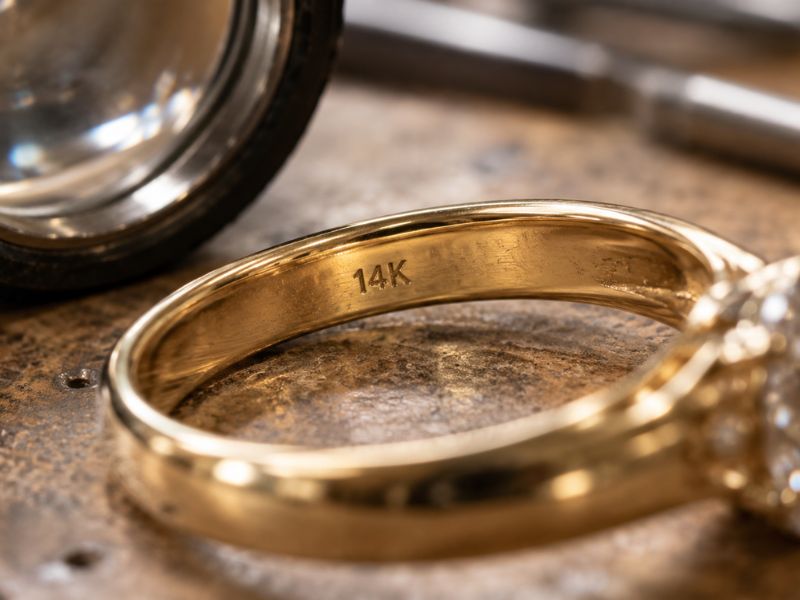
A 14K ring is less than 60% gold, so its gold value is lower than its total weight suggests. The karat stamp usually appears inside a ring band, on a necklace clasp, or on the back of a pendant.
Craftsmanship & Brand Names
The price of a piece of jewelry includes the cost of making it. Turning raw gold into a finished ring or necklace takes skilled work, such as designing the piece, setting stones, and finishing it by hand. The more detailed the work, the more labor it requires, and that labor cost is added to the price of the piece on top of the price of the gold itself.
Brand names can raise the price further. Jewelry from a well-known brand or designer usually costs more than a similar unbranded piece, because buyers are also paying for the brand’s reputation.
That premium matters when it’s time to sell. A signed piece from a recognized maker can hold value well beyond its gold content. A plain, mass-produced chain will usually be valued much closer to the price of the actual gold content it contains.
How To Estimate What Your Gold Jewelry Is Worth
A rough estimate of a piece’s gold value, known as its melt value, takes four steps:
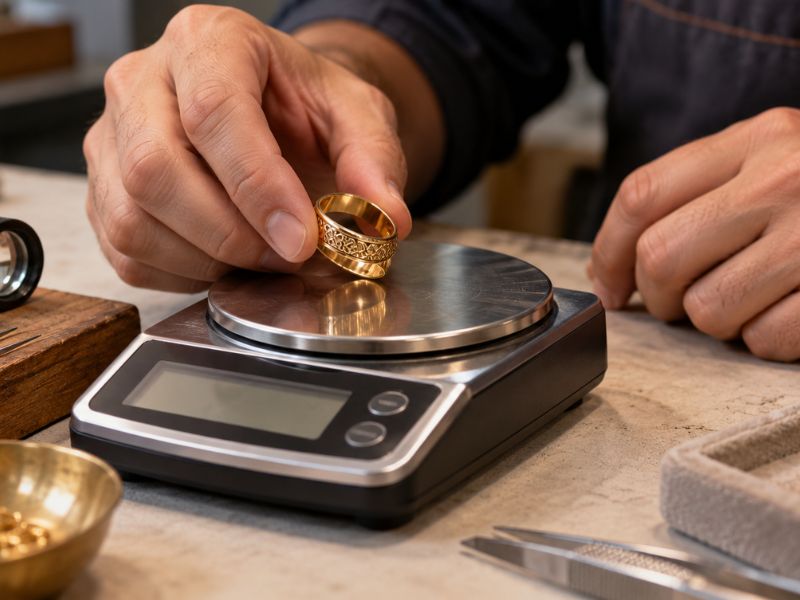
- Find the karat stamp. Look for a mark like 10K, 14K, or 18K. Older or European pieces may use numbers instead: 417 for 10K, 585 for 14K, and 750 for 18K.
- Weigh the piece in grams. A kitchen scale isn’t precise enough, so a jeweler’s scale that reads to 0.01 grams works best. Gemstones add weight but have no melt value.
- Check the current spot price. Spot prices are usually listed per troy ounce, the standard unit for precious metals. Many sites also list a per-gram price, which keeps the math simple.
- Do the math. Divide the karat by 24 to turn it into a decimal. Multiply that decimal by the weight in grams, then multiply by the spot price per gram.
Melt Value = (Karat ÷ 24) × Weight in Grams × Spot Price per Gram
Here’s the math for a 10-gram 18K ring at a spot price of $132.54 per gram:
- 18 ÷ 24 = 0.75
- 10 grams × 0.75 = 7.5 grams of pure gold
- 7.5 × $132.54 = $994.05
That figure is a starting point.
Dealers usually pay a little less than melt value. The difference covers their costs, such as testing the gold and sending it to be refined. On the other hand, a well-known maker, good condition, or a standout design can make a piece worth more than its melt value.
Want An Honest Gold Valuation?
The factors affecting the price of gold include supply and demand, the strength of the US dollar, inflation, central bank buying, and limited mining supply. Those factors set the spot price. From there, a piece’s value depends on its karat, the craftsmanship behind it, and the name of the brand or designer.
As a luxury alternative lender, PCL Group provides private, one-on-one gold valuations in downtown Jacksonville. Each appointment is transparent, never rushed, and comes with no obligation. Clients can sell a piece outright, use it as collateral for a short-term loan, or learn what it’s worth.
Factors Affecting The Price Of Gold: FAQs
No time of year guarantees a lower price. Jewelry demand tends to rise around wedding seasons and holiday periods, but jewelry is only one part of the market. Larger forces like the US dollar, interest rates, and world events can outweigh any seasonal pattern in affecting the price of gold.
Constantly. Gold trades around the world 24 hours a day, and its spot price can change by the second. The London Bullion Market Association also publishes a benchmark gold price twice a day, which much of the industry uses as a reference.
Yes. A collateral loan lets an owner use gold jewelry, coins, or bullion to secure a short-term loan without giving up the piece for good. PCL Group holds the item securely during the loan and returns it once the loan is repaid. The evaluation process is the same as for a sale, so clients can weigh both options in one appointment.