
If you’ve ever looked at a piece of jewelry and seen a tiny stamp like “14K” or “18K” inside the band, that number is telling you something specific about what you’re holding. It’s an indication on the gold karat scale, the system used worldwide to measure how much actual gold is in an item versus how much other metal mixed in. Once you understand how it works, those stamps stop being cryptic jewelry-store code and start being genuinely useful information, whether you’re evaluating an inheritance, deciding whether to sell or borrow against a piece, or just trying to figure out what’s sitting in your jewelry box.
Key Takeaways: Gold Karat Scale
- The gold karat scale runs from 1 to 24, with 24 karat being pure, unmixed gold.
- Lower karat numbers mean more of the metal is alloy (other metals) rather than gold.
- The most common purities you’ll see in jewelry are 24k, 18k, 14k and 10k gold.
- You can get a rough read on purity from stamps, but tools like an XRF machine or acid testing give a more precise answer.
- Higher karat gold is softer and more valuable per gram. Lower karat gold is more durable and more affordable.
How Does The 24-Karat Scale Work?
To understand the scale, think of gold as being made up of 24 equal parts. The karat number just tells you how many of those parts are actual gold, and how many are other metals mixed in. So 24-karat gold is 24 out of 24 parts gold, as pure as it gets, at 99.9% gold content. 18-karat gold is 18 parts gold to 6 parts other metal, or 75% pure. 14-karat is 14 parts gold out of 24, about 58.3%. And 10-karat is 10 parts out of 24, roughly 41.7% gold, the lowest purity still legally sold as “gold” in the U.S. until the FTC revised its Jewelry Guides in 2018 and dropped that threshold. Today, any karat can technically be marketed as “gold” as long as the karatage is clearly disclosed, though 10-karat remains the accepted industry floor for plated and vermeil pieces, and most solid gold jewelry on the market still sticks to 10-karat or higher.
That’s the math behind every stamp you’ll ever see on a ring, chain, or coin. The karat number isn’t a grade or quality rating the way you might expect. It’s simply a fraction of how many of the 24 parts are gold.
Gold Karat Purity Chart
Purity is really just the ratio of gold to alloy, and that ratio is what the gold purity scale is measuring. Higher purity means richer color and more value; lower purity means more durability, which is why different karats get used for different things.
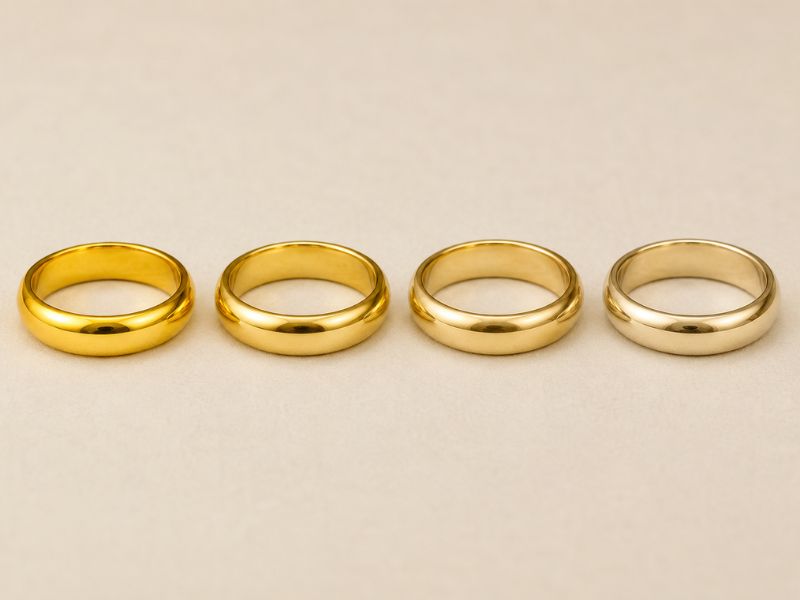
| Karat | Gold Content | Common Alloys | Typical Use |
| 24K | 99.9% pure | None (or very small amounts of trace) | Bullion, coins, investment bars |
| 18K | 75% | Copper, silver, zinc | Fine jewelry, engagement rings |
| 14K | 58.3% | Copper, silver, zinc | Everyday jewelry (U.S. standard) |
| 10K | 41.7% | Copper, silver, zinc | Budget jewelry, class rings |
Explaining Common Gold Purities
24-Karat Gold
This is gold in its purest commercial form, and because it contains the most actual gold, it’s also the most valuable per gram of any karat. It’s soft enough that it dents and scratches easily, though, which is why you rarely see it used in jewelry meant for daily wear. Instead, 24K shows up most often in bullion coins and bars, where the goal is maximum purity for investment purposes, not durability.
18-Karat Gold
At 75% gold, 18K strikes a balance between richness of color and enough structural strength to hold gemstones securely. It’s a common choice for engagement rings and fine jewelry in Europe, where higher-purity gold is culturally preferred over the lower karats common in the U.S. market.
14-Karat Gold
This is the default purity in a lot of American jewelry. At just over 58% gold, 14K is noticeably more durable than 18K or 24K, resists scratching better, and costs less, without looking dramatically different in color unless you’re comparing pieces side by side. That combination of durability and affordability is why it’s the go-to choice for engagement rings, wedding bands, and everyday pieces like chains and bracelets meant to hold up to daily wear. The tradeoff is value: with less gold content than 18K or 24K, 14K pieces are worth less per gram, even when the craftsmanship is comparable.
10-Karat Gold
At 41.7% gold, 10K is the least valuable of the common purities, but also the most durable and least expensive. It’s the toughest of the bunch, which makes it a practical pick for rings or bracelets that take daily wear and tear, though the lower gold content means less resale value per gram.
How To Measure Gold Karats
If you’re trying to figure out where a piece falls on the gold karat scale, there are a few different ways to check, ranging from a quick visual once-over to lab-grade testing.
Reading Stamps
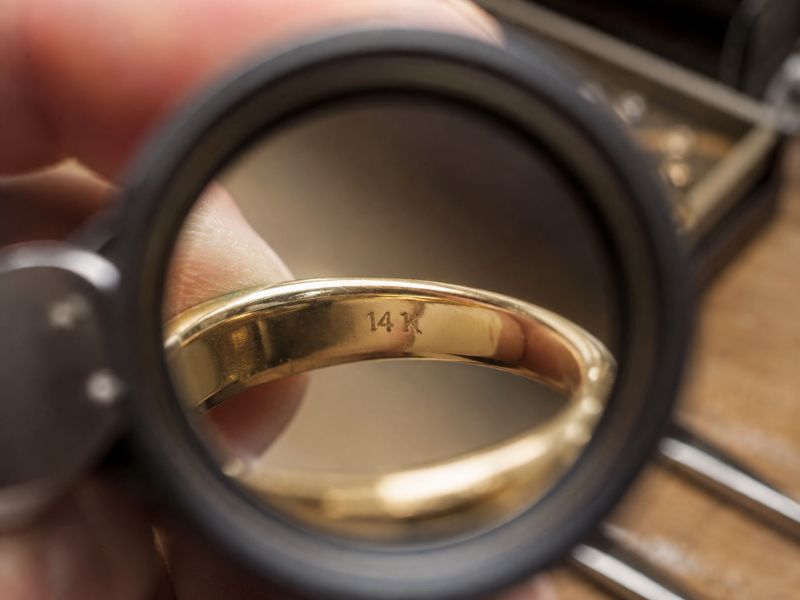
The fastest way to get a rough idea of purity is just looking for a stamp. Most gold jewelry is marked with its karat weight (24K, 18K, 14K, 10K) somewhere inconspicuous, often on the inside of a ring band or on the clasp of a necklace. It’s a good starting point for identifying what you have, but stamps can wear down over time or, in rare cases, be inaccurate or counterfeit, so it shouldn’t be your only method if you’re planning to sell, use it as loan collateral, or otherwise rely on an accurate number.
Gold Karat Tester
An electronic gold karat tester is a handheld device with a small probe that sends a low electrical current into the metal and measures how it responds, since gold and its common alloys conduct electricity differently depending on purity. The device compares the reading against known values and gives a quick digital readout of the estimated purity, without leaving any mark on the piece. It’s faster and more consistent than reading a stamp alone, and doesn’t require sending anything to a lab, which makes it a common tool for jewelers and pawn or lending professionals to use as they do quick, in-person evaluations.
Acid Test
Stone-and-acid testers are one of the oldest methods of figuring out how to measure gold karat by hand. The piece is rubbed across a dark testing stone, which leaves a faint streak of metal on the surface, then a drop of acid formulated for a specific karat threshold is applied to that streak. Testing kits usually include acids calibrated to a few different levels, like 10K, 14K, and 18K, so you can narrow down the actual purity by testing the streak against them in sequence. If the gold is at or above the karat that acid is calibrated for, the streak resists it and stays intact. If it’s below that purity, the acid eats through the streak and it disappears. It’s an inexpensive testing method and fairly quick, though it takes experience to read the results accurately, and it can leave a small mark on the item being tested.
XRF Testing
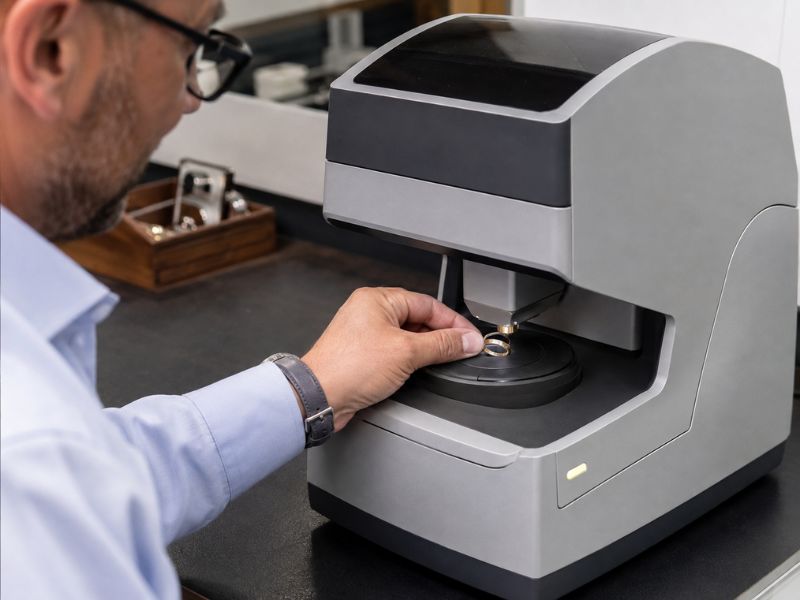
X-ray fluorescence (XRF) testing is the most precise option available. The machine fires X-rays at the piece, which causes the metal’s atoms to emit their own secondary X-rays back, a process called fluorescence. Since every element emits a distinct wavelength when this happens, the machine can read that pattern and identify the exact elemental makeup of the piece, without melting, scratching, or damaging it at all. This is the standard used by serious appraisers, refiners, and lenders when exact accuracy is necessary. It removes the guesswork entirely.
Why Is Gold Mixed With Other Metals?
Pure 24K gold is too soft for most everyday use. On its own, it bends, scratches, and wears down quickly, which is a problem for anything meant to survive years of wear: a ring, a bracelet, a watch case, and other common types of jewelry. Mixing in metals like copper, silver, or zinc solves that durability issue by hardening the final product.
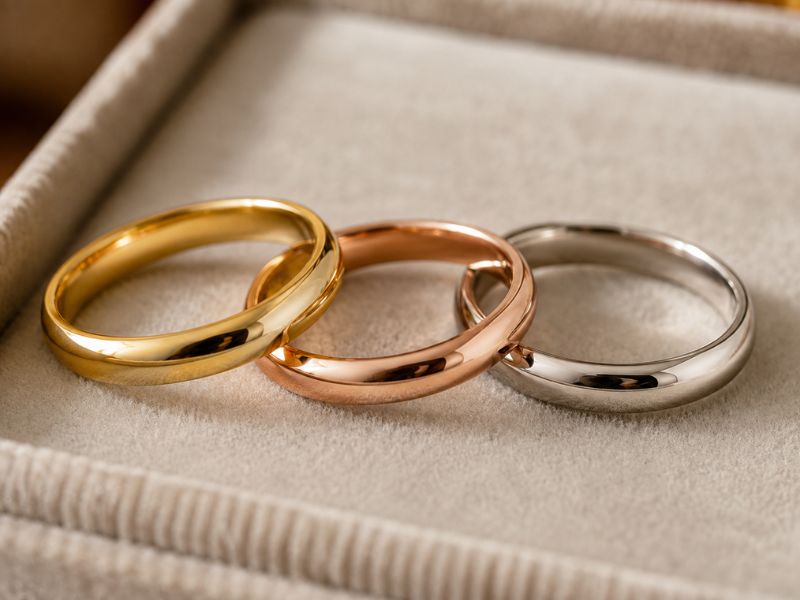
Durability isn’t the only reason to mix gold with other metals. Alloying is also how gold gets its color options: copper pulls it toward a rose or reddish tone, while silver and palladium push it toward white gold. Plenty of buyers specifically want a rose gold or white gold piece rather than traditional yellow gold.
The tradeoff when mixing gold with other metals is straightforward: lower purity in exchange for more durability and more design flexibility.
Overview Of The Gold Karat Scale
At its core, the gold karat scale is just a fraction out of 24, telling you how much of an item is made up of actual gold versus alloys. Once you can translate 24K, 18K, 14K, and 10K into their actual gold percentages (99.9%, 75%, 58%, and 42%), the stamps on jewelry stop being a mystery.
But knowing the scale only goes so far. When you’re buying, selling, or trying to value something specific, stamps and take-home testers can only tell you so much. That’s where professional evaluation comes in.
PCL Group offers private, one-on-one evaluations for gold, jewelry, and coins, whether you’re looking to sell, borrow against a piece, or simply get an accurate answer. Every evaluation is backed by the latest XRF technology to verify purity, along with Sigma Metalytics tools designed specifically for testing gold and silver coins, so you can trust the number you’re given. Reach out to schedule a consultation.
The Gold Karat Scale: FAQs
On the gold karat scale, pure gold sits at 24 karats. At this level, gold is 99.9% pure, with only trace amounts of other elements. It’s considered too soft for most jewelry, which is why it’s more commonly found in bullion coins and investment-grade bars.
There’s no single right answer because it depends on priorities. 14K is the most popular choice for wedding rings in the U.S. because it holds up well to daily wear while still looking rich in color. 18K offers a deeper gold tone and higher purity but is softer and more prone to scratching. 10K is the most durable and budget-friendly option, at the cost of a lighter gold color and lower resale value.
These two words sound identical but measure completely different things. Karat (with a K) measures gold purity on the 24-part scale described above. Carat (with a C) measures the weight of gemstones, including diamonds. One carat equals 200 milligrams. So, a piece of jewelry can have both a karat rating for its gold and a carat weight for its stone, and the two numbers have nothing to do with each other.
